
SWL Guide — Radio Society of Sri Lanka
How to send an SWL report to a radio amateur station
A beginner’s guide for shortwave and VHF listeners who want to connect with ham radio operators — and maybe earn a QSL card in return.
Step 1
What is an SWL report?
An SWL (Shortwave Listener) reception report lets a radio amateur station know that you heard them — when, where, and how well. Unlike reports to broadcasting stations, you don’t need to transcribe the conversation between the two operators. Just note the key details of what you heard and how your receiver performed.
Step 2
What to include in your report
- ✓Your name (Handle) — your first name or nickname is fine
- ✓QTH (Location) — your city, town, or district
- ✓Date and time of reception — use UTC if possible (Sri Lanka Standard Time + 5h30m = UTC)
- ✓Frequency or band — e.g. 7.060 MHz or 145.650 MHz
- ✓Callsigns heard — e.g. 4S7VK in QSO with 4S6TMP
- ✓Signal strength — use the S-scale in the next section to describe what you heard
- ✓Receiver and antenna — make, model, and type of antenna you used
- ✓Something about yourself — how long you’ve been listening, your interest in radio, etc.
- ✓A photo of your listening shack — optional, but hams really love to see these!
Signal strength reference
The S-scale — how strong was the signal?
| S-unit | Description | What you hear |
|---|---|---|
| S1 – S2 | Barely perceptible | Very faint, hard to make out |
| S3 – S4 | Weak | Audible but requires concentration |
| S5 – S6 | Moderate | Reasonably clear with some noise |
| S7 – S8 | Good | Clear and easy to follow |
| S9+ | Excellent | Strong, full quieting |
If your receiver has an S-meter, read it directly. If not, just describe what you heard — “clear with occasional noise” or “barely audible” works perfectly well.
Example
What a good report looks like
Dear 4S6TMP,
On 14 April 2025 at 0200 UTC, I heard you in QSO with 4S7VK on 7.060 MHz (40m band). Signal was approximately S7 — clear and easy to follow throughout the contact.
I am listening from Kandy using a Sangean ATS-909X with a 10m end-fed wire antenna. I have been a shortwave listener for about two years and am hoping to sit the RAE exam later this year.
Please find a photo of my listening shack attached. I would be very happy to receive your QSL card.
73, Kamal — Kandy, Sri Lanka
Listen now — RSSL VHF Net
A great place to start: tune in to the RSSL net
If you are a VHF listener anywhere in Sri Lanka, the RSSL VHF Net is the perfect place to practise receiving and send in your first signal report. The net runs every evening at 9:00 PM through the RSSL Amateur Radio Repeaters located at Pidurutalagala — the highest point on the island — and Yatiyanthota, giving excellent coverage across the country.
Different net controllers take the net each evening, giving you a variety of signals and operating styles to listen to.
You can receive the net using any VHF-capable radio, a commercial scanner, a software-defined radio (SDR), or even a simple FM receiver that covers the 144–146 MHz band. A basic quarter-wave vertical antenna is all you need to get started.
Step 3
How to send your report
For VHF net reports, send your signal report directly to the net controller, to RSSL QSL Bureau or email . They will read it out during the net for the whole country to hear — your QTH and signal level help RSSL map repeater coverage across Sri Lanka.
For HF and other reports, post your report to the RSSL QSL Bureau. Include all the details listed above and provide a mailing address so RSSL can send you a QSL card as a thank-you for your effort.
Post your reception report to the RSSL incoming bureau:
Radio Society of Sri Lanka (RSSL)P.O. Box 907
Colombo, Sri Lanka
Prefer to send it digitally? You can also email your reception report — including any photos of your shack — to the RSSL Awards desk:
[email protected]Want a quicker reply? Include a pre-paid, self-addressed, stamped envelope (SASE) with your report. It’s not required, but it makes it much easier for the station to send your QSL card back promptly.
What happens next
QSL cards and what to expect
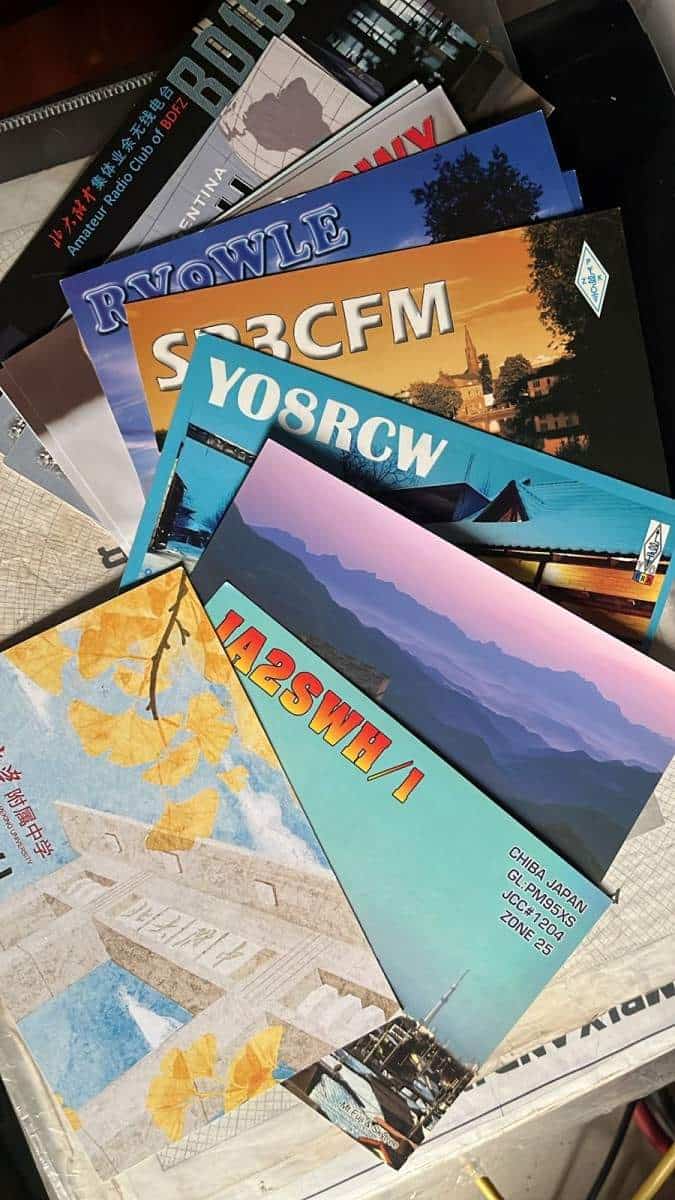
Most amateur radio operators are delighted to receive a well-written reception report and will reply with a QSL card — a small postcard confirming the reception. Don’t be discouraged if you don’t always get a reply; life gets busy. A thoughtful, detailed report with a photo of your shack significantly improves your chances!
Listening to the RSSL VHF Net is also a great way to get familiar with amateur radio procedure, terminology, and operating style — especially if you are planning to sit the Radio Amateurs Examination (RAE) and get your own callsign. Visit learn.rssl.lk to find out more.
Published by the Radio Society of Sri Lanka (RSSL) · All rights reserved.